Realism represents everyday scenes and events as they actually look. I admire this style of art for its realistic beauty. The artists created these paintings as they found them. They didn’t arrange anything in the scene or tell anyone to pose. Winslow Homer and Edouard Manet are two artists that painted in this style. I particularly like Homer's Artists Sketching in the White Mountains.
Friday, May 8, 2009
Realism
Realism represents everyday scenes and events as they actually look. I admire this style of art for its realistic beauty. The artists created these paintings as they found them. They didn’t arrange anything in the scene or tell anyone to pose. Winslow Homer and Edouard Manet are two artists that painted in this style. I particularly like Homer's Artists Sketching in the White Mountains.
Thursday, May 7, 2009
Impressionism and Post-Impressionism
I've found Impressionism to be the most enjoyable art period we've gone over so far. This style consists of engaging and attractive scenes painted with more light and brighter colors. It also portrays a sense of change and movement in the scene. Nature is shown in its favorable side too. The defining characteristic of this style, however, is unmistakenly the way the paintings are made up of tiny dabs or spots of color. I prefer Monet's work the most due to his use of bright colors and open form. Other artists of this period, like Renoir and Degas, also are popular.
From this style, Post-Impressionism developed. Younger artists such as Vincent van Gogh, Paul Gauguin, Georges Seurat, and Henri de Toulouse-Lautrec defined this era, using color, pattern, form, and line in new ways based off of Impressionism. Camille Pissarro and Seurat both used the pointillism technique. Paul Cézanne is also considered a Post-Impressionist artist.
Degas The Glass of Absinthe NYC Field Trip Reflection
I really enjoyed our field trip to NYC to tour the Whitney Museum and MoMA. Our tour of the museums, especially with the tour guides, got us think about what makes art art. The true definition of art varies from person to person. There's no denying art is subjective. People deem whether art is art based on their personal beliefs and experiences. Take Jenny Holzer's Protect Project-Redaction Paintings for instance. Although the redaction paintings are copied documents from the internet, they are blown up to emphasize a point--that as Americans we have access to these facts through the Freedom of Information Act, yet hardly anyone knows anythin about this war in the Middle East. Instead, we rely on the biased media ato tell us what's going on. Also, Holzer puts her own take on these "redaction paintings" (redaction meaning to edit and make ready for publication). I think art is different for each person. It is how individuals express their ideas and communicate their beleifs. Jenny Holzer just does this in a way that some people disagree with. If this isn't art, than what is it? Just an aesthetic opinion? It's up to us to decide.
Neoclassicism
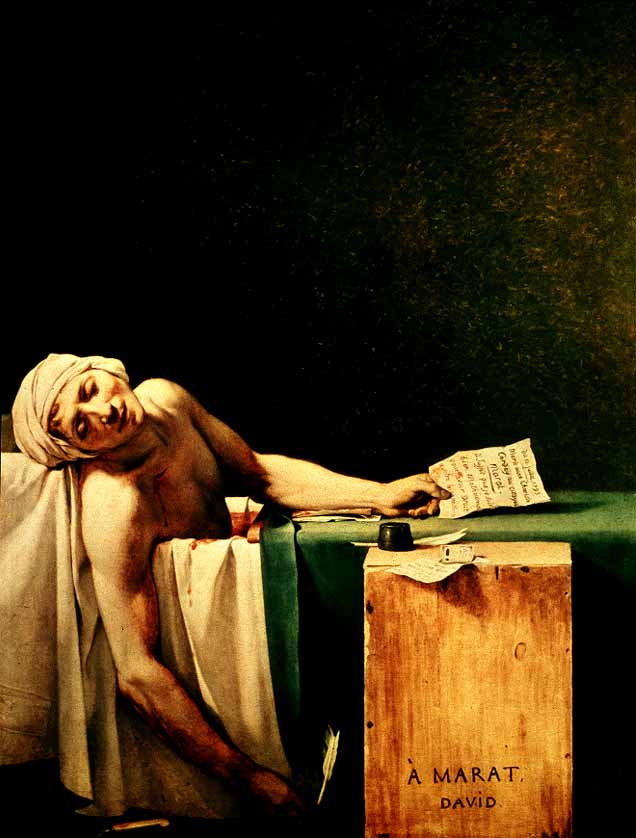
Jacques-Louis David, often considered the "official" painter of the revolution, was the leading figure of Neoclassicism. Neoclassical art developed in the mid-18th to early-19th centuries. It is a solemn form of art, referring back to the style of ancient Rome and Greece. One of his paintings, The Death of Marat, was created in 1793. I like how the subject is illuminated, while the background is dark. Neoclassicism borrows this technique from the Baroque period.
Romanticism
Romanticism is the style that portrays dramatic and exotic subjects perceived with strong feelings. Eugene Delacroix’s romantic paintings include stylistic traits such as glowing colors and swirling action. The Lion Hunt (above) depicts these elements of style. Personally, I don’t like this style that much. However, I do think its interesting how this artist began to paint using blurred colors to represent motion. I prefer the work of John Constable in The Traveller as he uses tiny dabs of pure color with bits of white to capture the changing face of nature.
Monday, April 20, 2009
Rococo Art
Rococo art replaced Baroque Art at the beginning of the 18th century. With this new period of art came new subject matter. Artistic techniques, however, as well as style, remained the same for the most part. Instead of painting pictures relating to religion, artists now placed emphasis on the frivolity of life. The Swing (above) is an example of such work. It pictures a well-dressed woman in a carefree mood being pushed by a man assumed to be her husband. Another man who appears to be staring into her eyes (or looking up her dress) is assumed to be her lover. This portrays the themes of love and romance in these works of art. They were thought to be better subjects than history anf religion in this time. Personally, I don't care for this style much, but I think it's cool that the artists had the guts to break away from a strictly religious subject matter.
Baroque Art
Baroque art originated in the beginning of the 17th century in Italy. Many works of art in the Baroque era were either dances, music, sculptures, literary works, or paintings. This art generally had religious undertones such as Bernini's Ecstacy of St. Theresa (pictured above). Other elements characteristic of this style is portrayal of movement, energy, and contrast. Often, images of the commonplace portrayed as something beautiful made an appearance in paintings, like in Girl with a Pearl Earring by Vermeer (below). I enjoyed watching the movie Girl with a Pearl Earring in class. I thought it was very interesting. People seem to hold as much fascination for it as with the Mona Lisa. The mystery of the painting is what captivates us.
Thursday, April 16, 2009
Ukrainian Eggs
The art of Ukrainian eggs, also known as pysanky, is a traditional craft practiced for a history of thousands of years. They are made by painting a wax design on the egg, then dipping them in a colored dye. After the first coat of dye dries, more wax is placed on the egg to allow the first color to remain. This process continues until the artist gets the achieved effect of multi-colored designs. Afterwards, the wax is melted off by a candle or small flame. Various patterns and colors also symbolize different qualities and emotions. They are now referred to as a talisman, or a good luck charm. Overall, I enjoyed this egg-dyeing process and think these eggs are a beautiful way to carry on cultural traditions.
Renaissance
The Renaissance was a period of cultural "rebirth", as it translates in Italian. Artists such as Leonardo da Vinci, Michelangelo, Raphael, and Botticelli flourished in this era. Great works of art like the Birth of Venus, The Mona Lisa (above), and the various paintings of the Sistine Chapel such as Creation of Adam (below) were created. Michelangelo’s work on the ceiling of the Sistine Chapel is his most famous, despite the fact that he wasn’t happy to paint it. Art, however, wasn't the only forte of the Renaissance. It was a time of knowledge and discoveries in all subjects--architecture, dance, literature, music, philosophy, and science to name a few. This was seen in da Vinci as the ultimate Renaissance man. He was not only a master painter, but also a skilled mathematician, engineer, inventor, anatomist, sculptor, architect, botanist, musician, and writer. His most famous work, the Mona Lisa, is a very mysterious piece because she has no eyebrows.
Tuesday, March 10, 2009
Mardi Gras
Mardi Gras, also known as Fat Tuesday, is a pagan holiday created as a huge party before Lent. People indulge in all their guilty pleasures before they have to give it up for Lent. They partake in dancing, drinking, partying, and general celebration. This holiday is widely celebrated in New Orleans. In Art History, we created our own “day” to commemorate the day before Ash Wednesday. Some people chose to indulge in food, like April’s Jerk Day and my Chocolate Chip Day, while others chose something healthier, like Rebecca’s Singing Day. Personally, I agree most with Kelly’s Relaxing Day. Lent should make you want to abstain from whatever you choose to give up, not indulge in it to the point where you don’t want it for forty more days.
Gothic Art
Dark, rich colors, heavy structures, metal embellishments, and gargoyles all come to mind when thinking of Gothic style. These descriptions pretty much held true when studying this unit. The Gothic period began in the mid-12th century and lasted until the end of the 15th or 16th century. I thought it was interesting that its name was given by critics who scorned the art of this period because it didn’t hold to the standards of ancient Greek and Roman art. It was named after Goths and Barbarians that brought the fall of Rome. So basically, its name derived from an insult. The cathedrals are evidence of this gothic style. I enjoyed making the rose windows and especially liked the contrast of the bright “stained glass” colors against the black.
Early Christianity
Illuminated manuscripts were the focus of our unit on Early Christian art. They were originally used to depict stories in the Bible. Calligraphers spent hours decorating these manuscripts, which are characterized by an enlarged first letter. I love the organic shapes used in the intricate ornamentation of the manuscripts. Flowers, vines with ivy leaves, acanthus leaves, curving lines, and various animals are often incorporated in the illuminated manuscripts. Our own interpretations of this ancient art included an inspirational quote, illuminated first letter, calligraphy writing, and decorated frame. I can hardly imagine how much time and detail the original artists had to dedicate to these manuscripts. Overall, I think illuminated manuscripts are a beautiful form of art.
Subscribe to:
Comments (Atom)