Realism represents everyday scenes and events as they actually look. I admire this style of art for its realistic beauty. The artists created these paintings as they found them. They didn’t arrange anything in the scene or tell anyone to pose. Winslow Homer and Edouard Manet are two artists that painted in this style. I particularly like Homer's Artists Sketching in the White Mountains.
Friday, May 8, 2009
Realism
Realism represents everyday scenes and events as they actually look. I admire this style of art for its realistic beauty. The artists created these paintings as they found them. They didn’t arrange anything in the scene or tell anyone to pose. Winslow Homer and Edouard Manet are two artists that painted in this style. I particularly like Homer's Artists Sketching in the White Mountains.
Thursday, May 7, 2009
Impressionism and Post-Impressionism
I've found Impressionism to be the most enjoyable art period we've gone over so far. This style consists of engaging and attractive scenes painted with more light and brighter colors. It also portrays a sense of change and movement in the scene. Nature is shown in its favorable side too. The defining characteristic of this style, however, is unmistakenly the way the paintings are made up of tiny dabs or spots of color. I prefer Monet's work the most due to his use of bright colors and open form. Other artists of this period, like Renoir and Degas, also are popular.
From this style, Post-Impressionism developed. Younger artists such as Vincent van Gogh, Paul Gauguin, Georges Seurat, and Henri de Toulouse-Lautrec defined this era, using color, pattern, form, and line in new ways based off of Impressionism. Camille Pissarro and Seurat both used the pointillism technique. Paul Cézanne is also considered a Post-Impressionist artist.
Degas The Glass of Absinthe NYC Field Trip Reflection
I really enjoyed our field trip to NYC to tour the Whitney Museum and MoMA. Our tour of the museums, especially with the tour guides, got us think about what makes art art. The true definition of art varies from person to person. There's no denying art is subjective. People deem whether art is art based on their personal beliefs and experiences. Take Jenny Holzer's Protect Project-Redaction Paintings for instance. Although the redaction paintings are copied documents from the internet, they are blown up to emphasize a point--that as Americans we have access to these facts through the Freedom of Information Act, yet hardly anyone knows anythin about this war in the Middle East. Instead, we rely on the biased media ato tell us what's going on. Also, Holzer puts her own take on these "redaction paintings" (redaction meaning to edit and make ready for publication). I think art is different for each person. It is how individuals express their ideas and communicate their beleifs. Jenny Holzer just does this in a way that some people disagree with. If this isn't art, than what is it? Just an aesthetic opinion? It's up to us to decide.
Neoclassicism
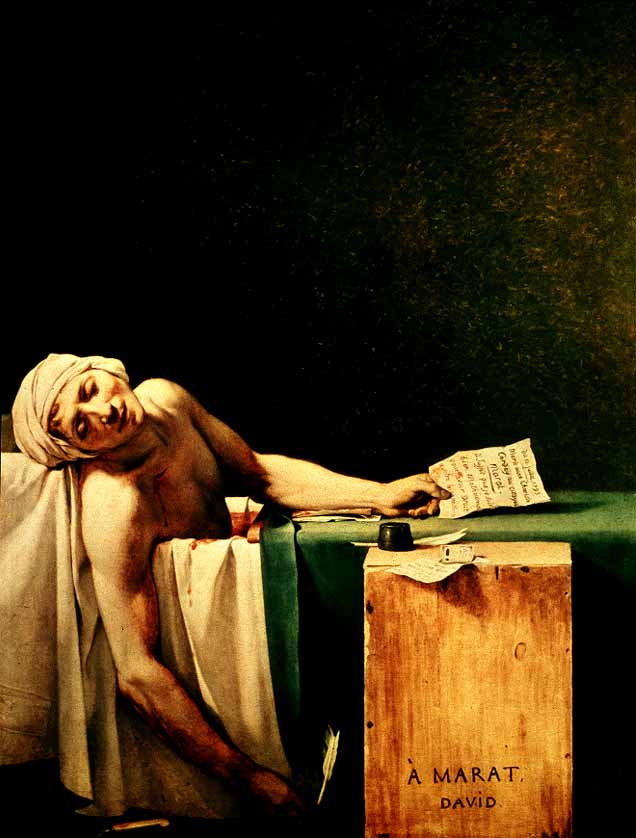
Jacques-Louis David, often considered the "official" painter of the revolution, was the leading figure of Neoclassicism. Neoclassical art developed in the mid-18th to early-19th centuries. It is a solemn form of art, referring back to the style of ancient Rome and Greece. One of his paintings, The Death of Marat, was created in 1793. I like how the subject is illuminated, while the background is dark. Neoclassicism borrows this technique from the Baroque period.
Romanticism
Romanticism is the style that portrays dramatic and exotic subjects perceived with strong feelings. Eugene Delacroix’s romantic paintings include stylistic traits such as glowing colors and swirling action. The Lion Hunt (above) depicts these elements of style. Personally, I don’t like this style that much. However, I do think its interesting how this artist began to paint using blurred colors to represent motion. I prefer the work of John Constable in The Traveller as he uses tiny dabs of pure color with bits of white to capture the changing face of nature.
Subscribe to:
Posts (Atom)